


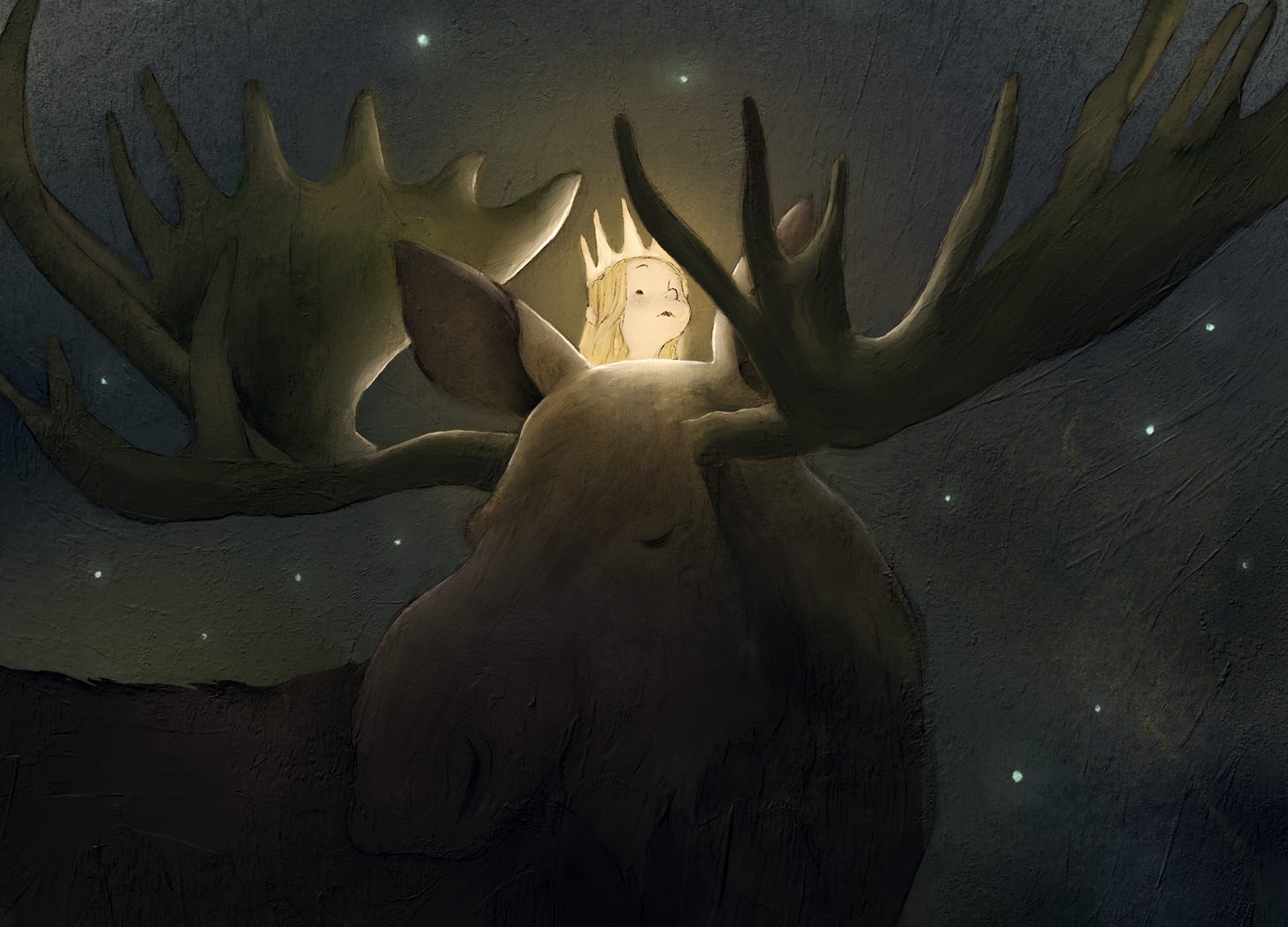
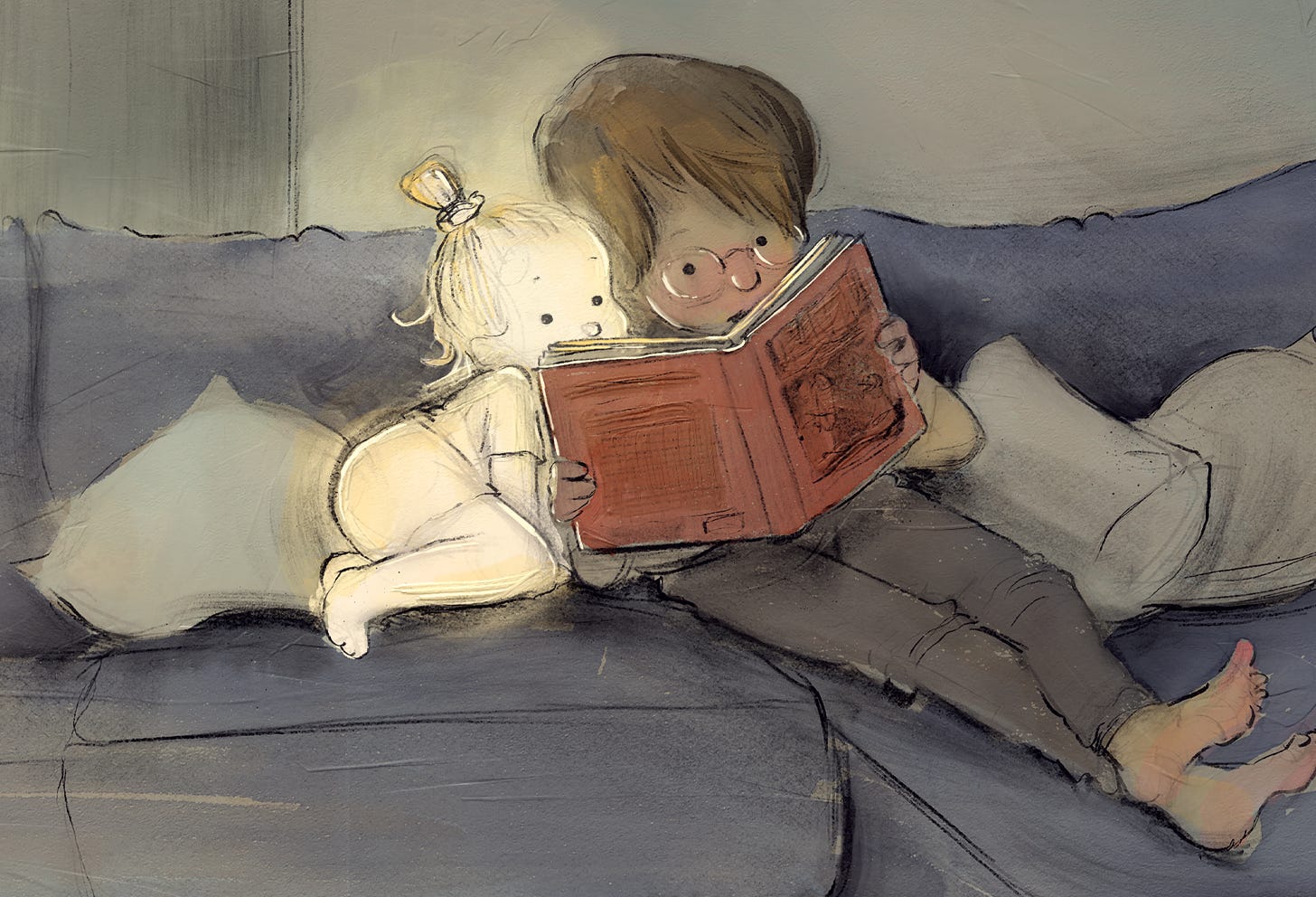
A little while ago, my three year old daughter and I found ourselves reading a book of Swedish fairy tales, illustrated by John Bauer. She was particularly taken by Leap the Elk and Little Princess Cottongrass by Helge Kjellin. We read it twice. John Bauer is one of my favourite illustrators, and his pieces for this story are some of his best and most well known. Nevertheless, I thought it would be fun to retell the tale with my own illustrations for this newsletter. That’s what I sat down to do. But that’s not what I did. Well, I drew some pictures, and I have them here to share. But it also turns out I had a few thoughts about the story. Thoughts about dark woods, innocent princesses and the responsibility of kings.
I won’t retell the tale in full, but I’ll give you a brief summary.
A child - Princess Cottongrass - has slipped away from her castle to play in a flowering meadow. She wears a crown, a white dress, and a golden heart pendant around her neck. She meets an elk (or what I would call a moose) called Longleg Leap. She implores Leap to take her with him. “Let me sit behind your neck”, she says, “and then carry me out into life.” Leap hesitates and warns her of the world’s dangers. But she insists, and he eventually obeys. On the road, they pass a series of threats. Each time, Leap warns the princess of the particular danger and gives her instructions on how to stay safe. Each time, however, she makes a mistake and loses something dear to her. First, she is tricked by elves who steal her golden crown. Next, she is tricked by a witch who steals her white dress. Lastly, they come to a murky, enchanted pool. “Hold on tight,” Leap warns. “There is danger under the water. Watch your golden heart!” But again, the princess does not listen. She loses her golden heart in the pool, and in searching for it, falls under a spell. Enchanted, she sends Leap away and gazes into the water. And as years pass, she is no longer a little girl, but a “slender plant, crowned with white cotton”, leaning over the edge of the pool, forever searching for a lost heart.
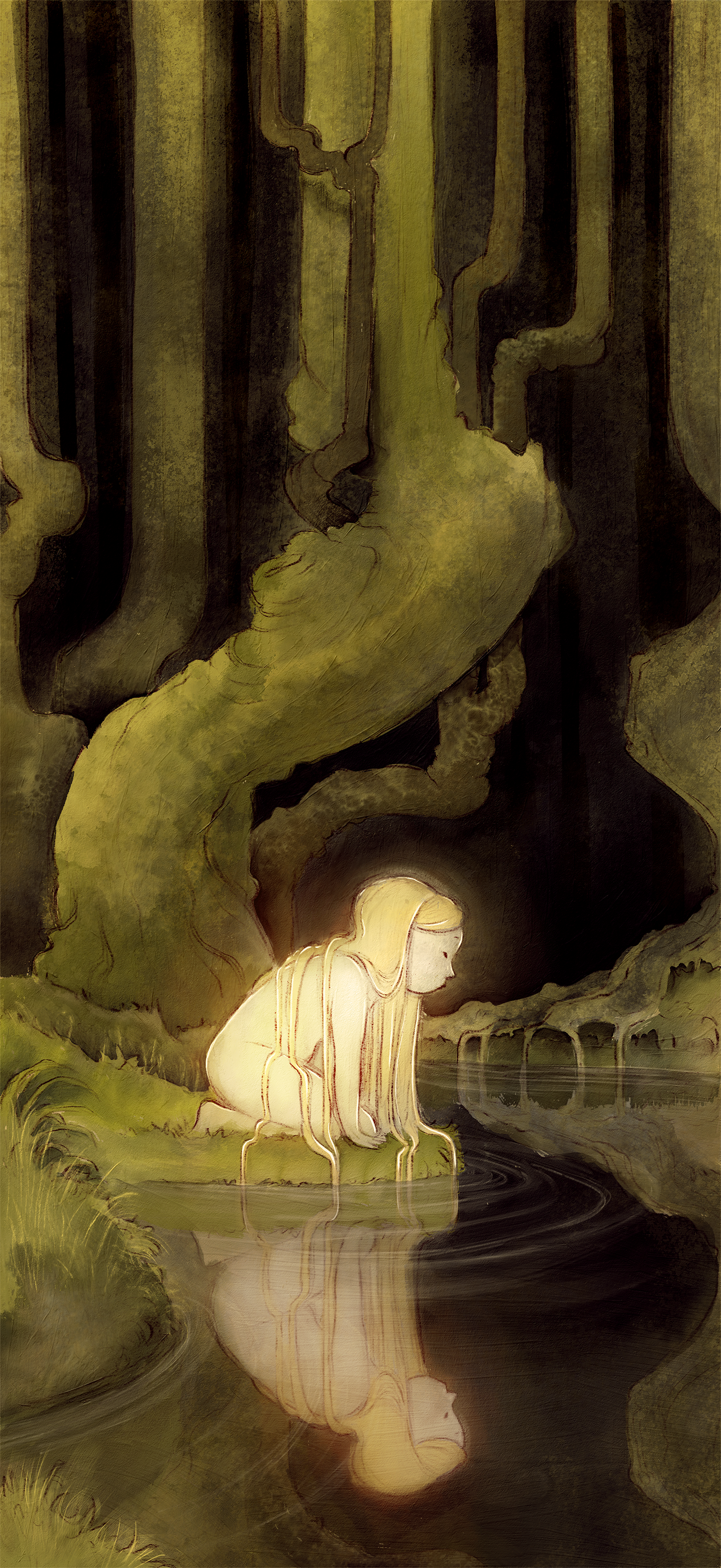
When I first discovered this story, I was attracted to the melancholy of it; to the haunting, quiet and poetic end of the poor princess. But reading it again, I found myself more specifically interested in Longleg Leap. What resonates most with me now is Leap’s terrible failure of responsibility. For all his strength and wisdom, he doesn’t live up to her trust in him. He seems committed to protecting her, and stands watch over her all night while she sleeps. But he gives her room to make mistakes, and when she makes them, he can’t keep her safe. I felt so irritated and angry by this. Why did it bother me so much? I didn’t know initially, but then it hit me: I was now reading the story as a father. Was I reading Leap as a father figure?
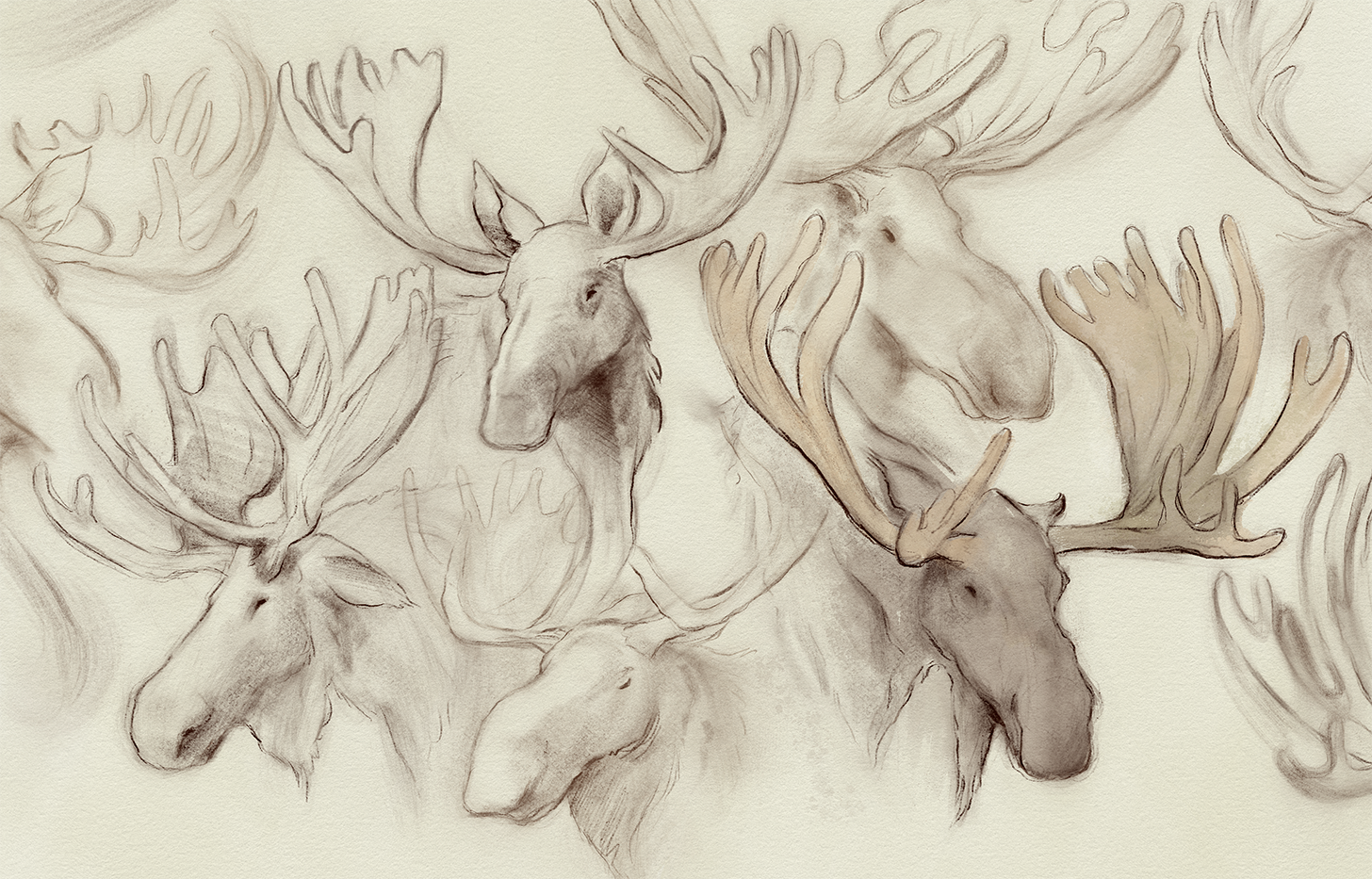
I don’t feel consciously insecure about parenting. I love it, and I’m good at it. But it wouldn’t be honest to say I didn’t dwell on the weight of it from time to time. Perhaps seeing Leap fail the child princess picks at some bubbling, buried insecurity about fatherhood. I don’t necessarily think Leap was written as a paternal figure. But he could be. And this explains why his character bothered me: seeing a father fail was frightening.
But there’s a flaw in this criticism. How much should Leap have intervened in the princess’s missteps? To guarantee her safety, Leap should have left her in the meadow by the castle, hidden and naive. Is that a better fate? Surely, to hide our kids too well from the dangers of the world will ultimately do them a more terrible harm. Kids need to walk away and into the woods to be tempted by elves and witches and enchanted tarns. They need to grow up. It makes me even more uneasy to think that Leap did everything right, to the same sad end. If he did fail, he was doomed to do so by the princess’s true parents - the King and Queen - who had already hidden her away from the world too long. Their smothering meant that Leap never stood a chance of guiding her safely through the woods.
What failed the princess was not Longleg Leap. She was failed by a lack of experience, a lack of fear, and a lack of fairy tales. Stories prepare us for the world, and the best ones have just the right amount of scary. My daughter wasn’t scared by this one, but others have frightened her a bit. What’s interesting is to see how much she enjoys dancing on the edge of that fear; right on the border between safety and imaginative overwhelm. She loves it. And she has her own way of managing the scariness of particular stories - she brings the scariest characters and scenarios willingly into our role-playing. Specifically, she asks me to play the scary characters in a game (again and again), and then she pacifies them; either defeating them, or demanding they become good. Put simply, she takes control of the story and conquers the things that at first frighten her. I watch her do this, and I think: oh, you’ll be fine in the woods. You’ll be perfectly, bravely fine.
Simon, this is a such a beautiful thoughtful post, and exquisite illustrations. I can see Bauer's inspiration, especially in the girl reflected in the pool, and also a little Virginia Sterrett - I think I'm thinking of her image with a very similar composition to Bauer's version - a girl riding a tortoise in front of very stylised trees. Your thoughts on parenting struck a chord too, with our eldest moving to Melbourne in a few weeks (I hope I've read her enough fairy tales!) and our youngest only a year behind her. Thank you so much for your wonderful work.
This was beautiful to read. Thank you for sharing so openly!