


I have a new picture book coming out called Going Home. It’s a simple story about a mouse father and child who spend a quiet day wandering and chatting. Along the way, they ruminate on the idea that everything is, in one way or another, on its way home. At first they’re talking about beetles and bees. But the idea becomes more abstract and soon it’s balloons, sticks and lost scarves that are also going home.
I set out to write about a young child’s comprehension of home as a predictable and inevitable return to safety, familiarity and comfort, and the wholesomeness and hopefulness of wishing that for everyone and everything. But there’s another subject in the story that springs quietly from a single illustration towards the end of the book. I intended this addition to be subtle. Present, but not prominent. And yet, as the book began to be marketed and reviewed, I was surprised to see this particular layer of the story given more attention than I expected.
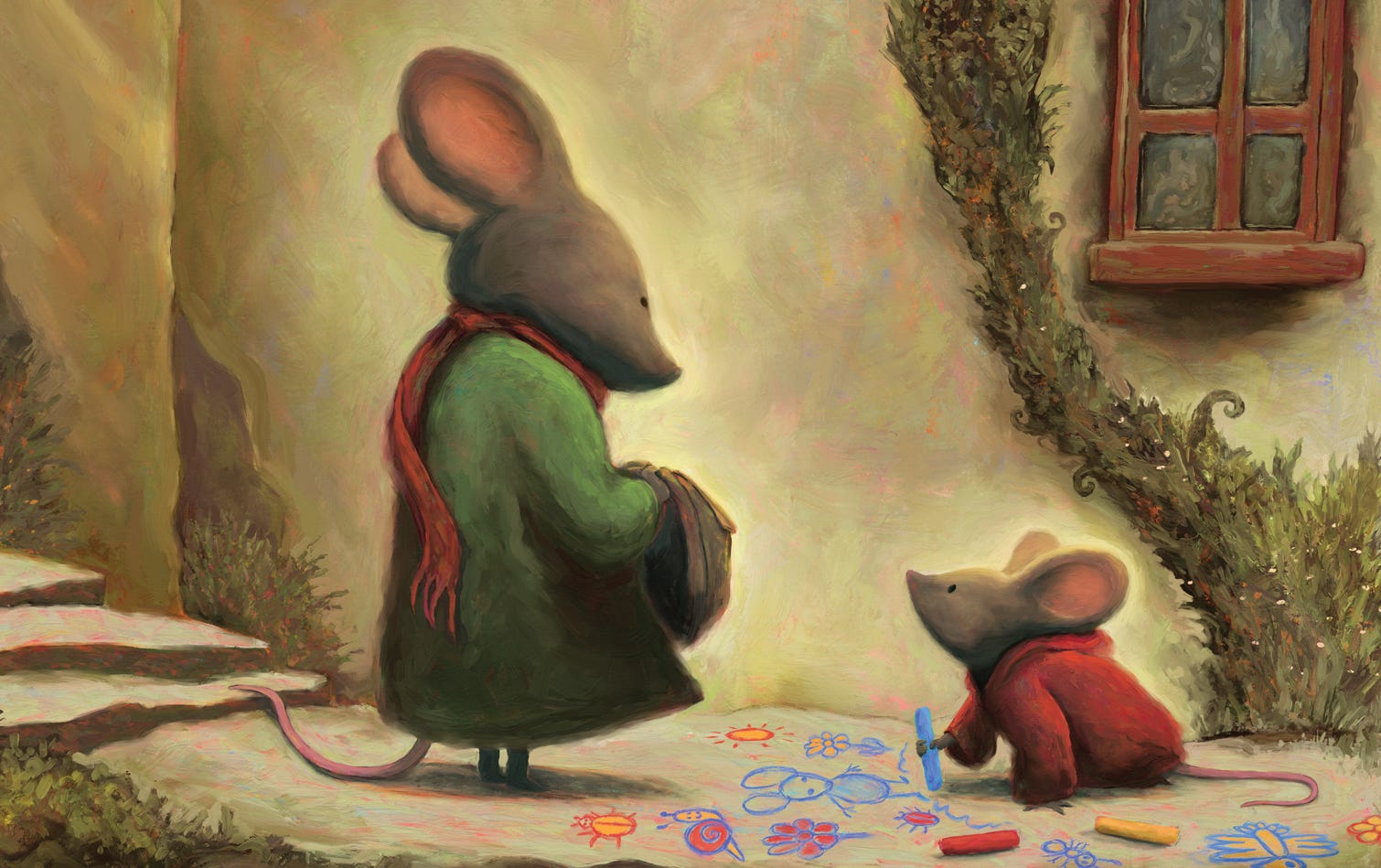
I wrote the story after a real day I spent with my daughter when she was about two years old. We were walking and talking and I commented on a car, suggesting it was going home. We then pointed out other things that might be going home, and she began to apply the idea to increasingly abstract things. What started with vehicles and bugs soon included clouds, raindrops and sticks floating in a creek. She decided that everything was on its way home. The game lasted the afternoon, but I was still thinking about it days later. In her experience of the world, wherever she was going, she always ended up safe at home. Why wouldn’t she conceive of home as the endpoint of all things? It was a sweet and cosy line of thought - just right for a picture book.
When I was drafting the images, I saw an opportunity to add something else to the emotion of the story. Towards the end of the book, the child-mouse reflects that “it’s good to know where things are going… and where other things have gone”. Accompanying the second part of that sentence are two images. The first is a picture of the child-mouse staring at an empty ice-cream cone, with the remnants of said ice-cream all over her face and coat. It’s a funny image and one of my favourite moments. The second image shows the two mice sitting together and looking at a photograph. There are three mice in the photo. Two of them are presumably the father and child. The implication of this illustration is that there is someone special who has gone.
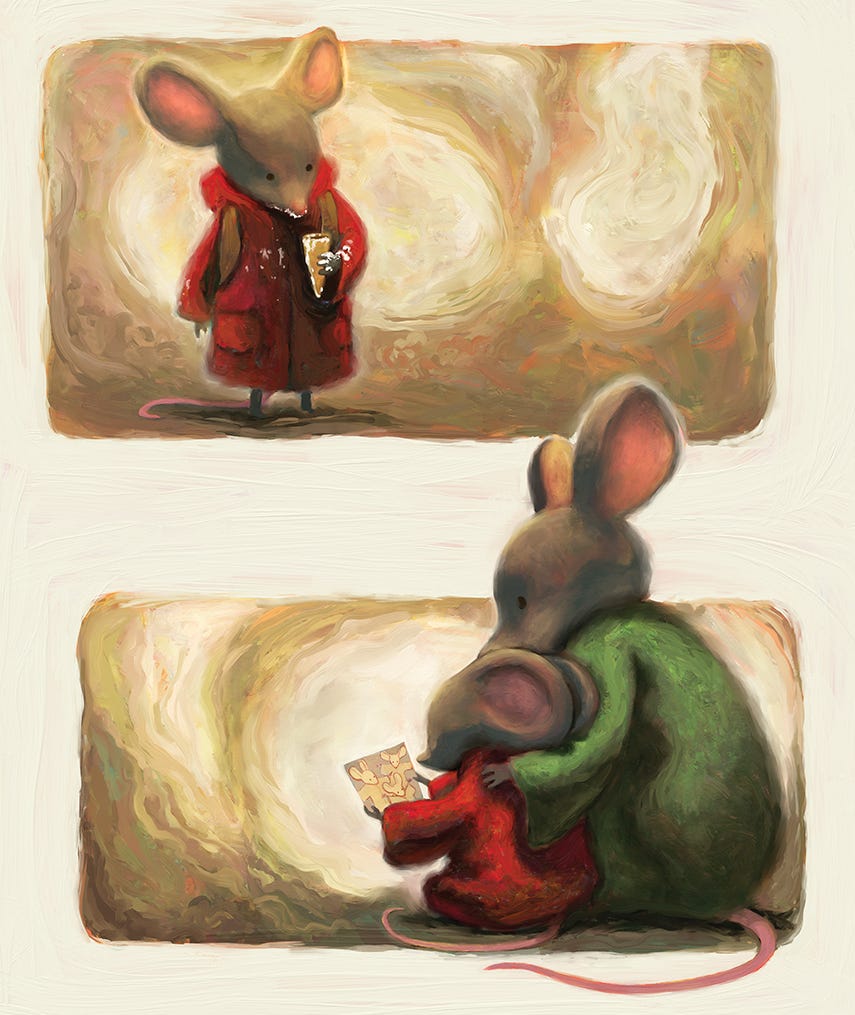
Nothing further is explained or implied about this third person. But if you pause here, the emotional scope of the book shifts. The father and child supposedly conceive of this absence as the person having gone home. And suddenly a book about a silly and meandering game of a conversation asks us to consider grief, impermanence, and even spirituality. If home is at the end of all things, then home and loss become linked. Home and death become linked.
I didn’t intend this line of thinking to be particularly noticeable. But my publishers noticed. On the back cover of the Australian edition, the book is described as “a beautiful and quietly meaningful tale of life, loss and love.” A blurb from the US publisher says that the book’s “open-ended questions might invite a broader exploration of loss and other universal themes.” And a recent book review on Instagram described the characters as exploring “questions of life and loss.” This reaction left me wondering if people were exaggerating the subtle implications of a single illustration. Worse still, were they misreading the book, and missing what I really wanted to talk about?
It recently occurred to me that it might actually be the other way around. What if I’ve misread my own writing? Looking at it now, it’s obvious that feelings about loss are scattered through the whole book, not just one illustration at the back. It’s called Going Home, but it’s also about things going away. It’s about the passing of time and things disappearing and how we make sense of that. How do we deal with things that we have and then don’t have? The answer these characters come up with is home - a destination that gathers and ties together the scattered pieces of a day. They suggest that things don’t go away behind us. They’re not lost in the past. They go home ahead of us, in the same direction we’re going. Because we’re going home too.
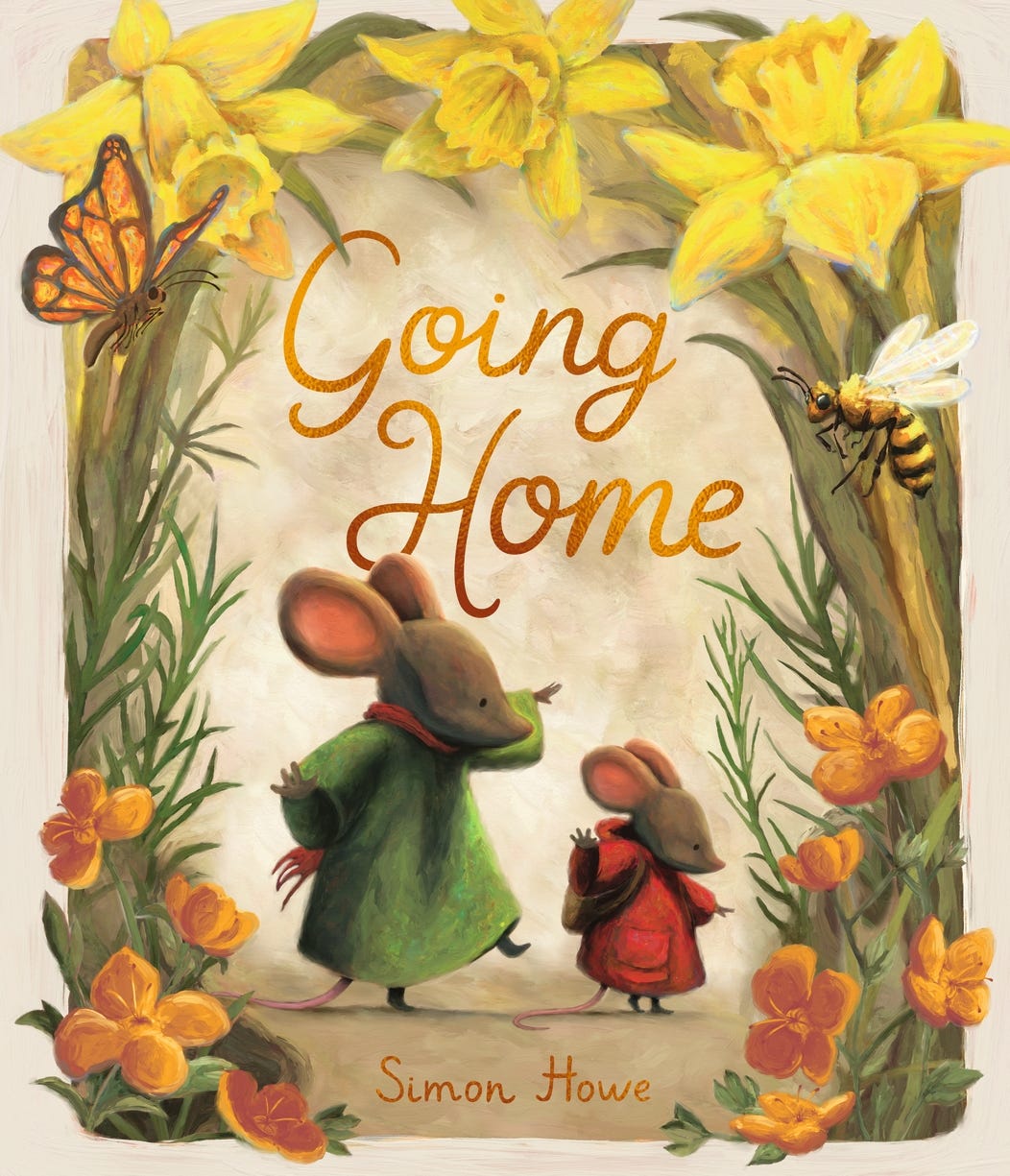
Going Home is available in bookshops in Australia and New Zealand from February 1st. This will be followed by foreign editions in the United States (under the title, Going Home With Dad), Italy, France, Moldova and Denmark.
We purchased this book today from the National Library in Canberra. It is quite simply, the most beautifully written and illustrated book I've ever read. It is tender, playful and poignant...I could not help but cry as I read it. Thank you Simon, for the gift of this book, and for using your gift of story telling and art, to connect with your readers so powerfully.
This is a wonderful and interesting post, especially the difference between your initial intent and readers’ responses. I believe every story reincarnates at least three times - when it’s written, when it’s illustrated and when it’s read.
Also, I love the illustration with an ice cream cone and a photograph. I’ll be doing a talk next month and I’m supposed to give next generation of illustrators some advice and I’ve been thinking what to say. One of the things would be “Stop focusing on making pretty images. Start focusing on making images that tell stories. And when I saw your illustration, I thought “This is exactly what I’m thinking of!” (Not that your work isn’t pretty 😂)
I’d love to read the whole book. I’ll try to see if I can get a copy in the UK.